

Bachelor of Architectural Engineering
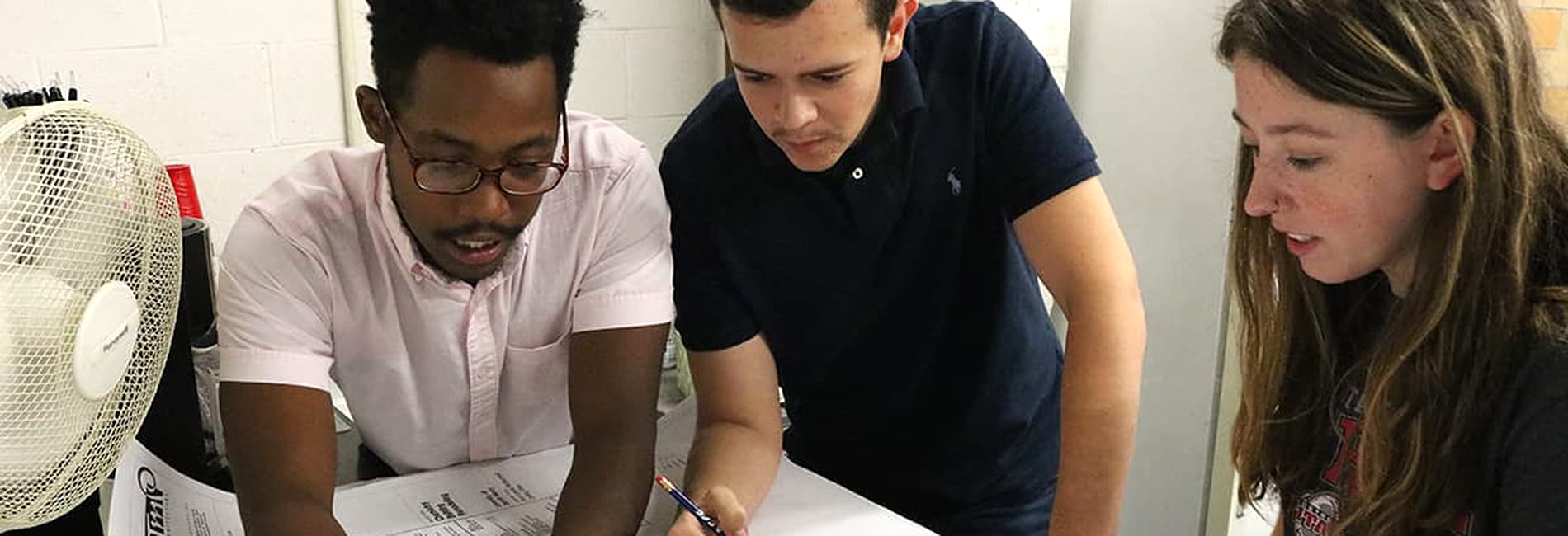
Curious About How Structures Are Built?
Do you enjoy being creative and seeing how engineering can turn ideas into innovative, efficient and inspiring structures?
Detroit Mercy’s 4½ - Year Bachelor of Architectural Engineering (BAE) degree combines architecture and engineering into one exciting degree. You’ll use both creativity and technical skills to design structures that improve the quality of life for people everywhere.
Career Prospects
With a bachelor’s degree in Architectural Engineering, you could become a:
- Architectural Engineer
- Structural Engineer
- Mechanical or Plumbing Systems Engineer
- Electrical or Lighting Systems Engineer
- Facade Engineer
- Fire Protection Engineer
- Construction Project Manager or Estimator
- Energy Modeler
- Urban Planner
- Building Technology Consultant
- Forensic Engineering Consultant


PAID Co-op Experiences

$125K is the annual salary for a Senior Architectural Engineer
The average pay range for an Architectural Engineer varies greatly, which suggests there may be many opportunities for advancement and increased pay based on skill level, location and years of experience.
ZipRecruiter 2025

Overall employment in architecture and engineering occupations is projected to grow faster than the average for all occupations from 2024-34. About 186,500 job openings are projected each year, on average.
Bureau of Labor Statistics
Bachelor of Architectural Engineering (BAE)
Design creative, practical and sustainable solutions that improve the places where people live and work. You’ll learn to balance function, safety, cost, appearance and environmental impact.
Architectural Engineering brings architecture and engineering together. You’ll take courses in both fields, learning how architects and engineers collaborate to turn ideas into real buildings and spaces.
Starting in your first year, you’ll study both architecture and civil engineering, giving you hands-on experience with the connection between design and construction.
-
Degree Requirements - Bachelor of Architectural Engineering (145 credits)
This information is from the current Undergraduate Academic Catalog
Architectural Engineering Major Courses (81 credits)
- AENG 4100 Architectural Engineering Integrative Design (Capstone) (3 credits)
- AENG 4112 Fundamentals of Engineering for Architectural Engineers (1 credit)
- ARCH 1100 Architectural Design I (4 credits)
- ARCH 1110 Visual Communication I (3 credits)
- ARCH 1190 Intro to Architecture I or UAS 1190 Intro to Architecture School (1 credit)
- ARCH 1200 Architectural Design II (4 credits)
- ARCH 1840 Structural Principles (1 credit)
- ARCH 1860 Environmental Principles (1 credit)
- ARCH 1880 Construction Principles (1 credit)
- ARCH 2110 Visual Communications III (3 credits)
- ARCH 2220 Architectural History and Theory II (3 credits)
- ARCH 2660 Building Environment I (1 credit)
- ARCH 2680 Building Construction I (1 credit)
- ARCH 2880 Building Construction II (1 credit)
- CIVE 3420 Structural Theory (4 credits)
- CIVE 3450 Construction Materials (3 credits)
- CIVE 3480 Geotechnical Engineering (3 credits)
- CIVE 3490 Geotechnical Engineering Laboratory (1 credit)
- CIVE 4680 Design of Steel and Concrete Structures (4 credits)
- ENGR 1000 Engineering Ethics (2 credits)
- ENGR 1050 Engineering Graphics and Design (2 credits)
- ENGR 1234 Engineering Math (3 credits)
- ENGR 3120 Statics (3 credits)
- ENGR 3130 Dynamics (3 credits)
- ENGR 3140 Fluid Mechanics (3 credits)
- ENGR 3150 Thermodynamics I (3 credits)
- ENGR 3170 Science of Materials (3 credits)
- ENGR 3200 Principles of Electrical Engineering (3 credits)
- ENGR 3240 Engineering Economy (3 credits)
- ENGR 3260 Mechanics of Materials (3 credits)
- ENGR 3270 Mechanics of Materials Laboratory (1 credit)
- ENGR 3400 Heat Transfer (3 credits)
- Technical Elective -select one course from the following (3 credits):
Engineering Foundation Courses for Architectural Engineering (43 credits)
- CHM 1070 General Chemistry I (3 credits)
- CHM 1100 Chemistry Laboratory I (1 credit)
- MTH 1410 Analytic Geometry and Calculus I (4 credits)
- MTH 1420 Analytic Geometry and Calculus II (4 credits)
- MTH 2410 Analytic Geometry and Calculus III (4 credits)
- MTH 3720 Differential Equations with Linear Algebra (4 credits)
- PHY 1600 General Physics I (3 credits)
- PHY 1610 General Physics Laboratory I (1 credit)
- PHY 1620 General Physics II (3 credits)
- PHY 1630 General Physics Laboratory II (1 credit)
- STA 2250 Statistics or MTH 4270 Applied Probability and Statistics (3 credits)
- Any additional math or science course at the 1000 level or higher (3 credits)
- ENGR 3000 Intro to Engineering & Science Co-op (1 credit)
- ENGR 3001 Cooperative Education in Engineering & Science I (0 credit) waived in some cases
- ENGR 3002 Cooperative Education in Engineering & Science II (0 credit) waived in some cases
- ENGR 3110 Professional Practice of Engineering (2 credits)
- CTA 3010 Engineering Co-op I (2 credits)
- CTA 3020 Engineering Co-op II (2 credits)
- CTA 3030 Engineering Co-op III (2 credits)
University Core Curriculum
In addition to the courses required for this program listed above, the student must also fulfill the requirements of the University Core Curriculum.
Some of these courses may be satisfied by courses in your program. Please review your Degree Evaluation or consult your academic advisor for more information.
Total credits required: 145 credits
 "My experience at Detroit Mercy has been one filled with work opportunities, connections and classes that helped streamline my career. The flowcharts for degrees are flexible, and allow for some personalization and minors that would be more difficult or impossible at other schools."
— Algird Szumlas '19
Learn by Doing — From Day One
Learn from Industry Experts
At Detroit Mercy, you’ll learn from experienced engineering faculty who are invested in your success. With an 11:1 student-to-faculty ratio, you’ll get the personal attention and support to grow in the classroom and beyond.
Build Your Network
Our faculty are active members of professional organizations, like
- American Society for Engineering Education (ASEE),
- National Society of Professional Engineers
- Engineering Society of Detroit
You’ll have plenty of chances to connect and network with industry professionals.
Hands-On Capstone, Co-op, Research
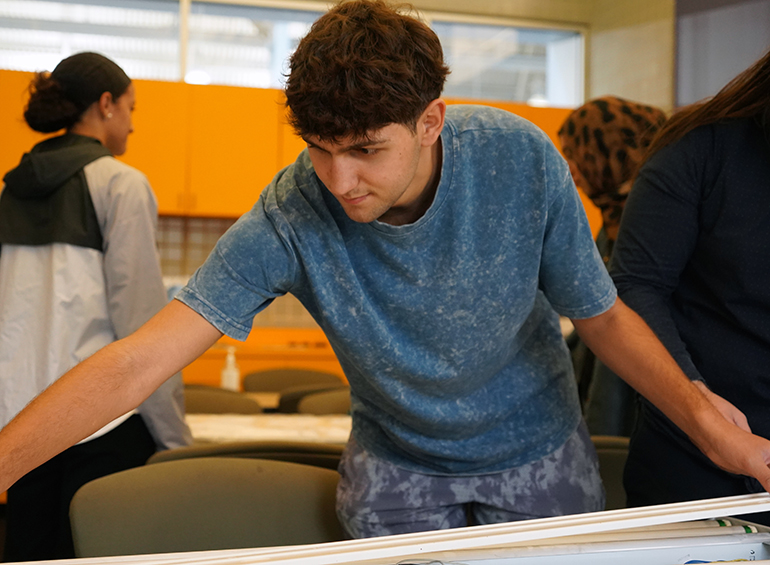
At Detroit Mercy, our Jesuit and Mercy mission means putting your learning into action. Starting in your first year, you’ll work on community-based design projects. As a senior, your capstone project will challenge you to solve a real engineering problem for a community partner.
Our mandatory co-op program, you’ll gain paid, hands-on work experience that gives you a strong edge in today’s job market. You can also explore related research.
Outside the classroom, join the American Society of Civil Engineers, contribute to the School of Architecture’s Dichotomy publication or compete in the annual concrete canoe competition.
-
Accreditation
 Bachelor of Architectural Engineering is accredited by the Engineering Accreditation Commission of ABET, http://www.abet.org.
Architectural Engineering Faculty

Utpal
Dutta
Professor of Civil, Architectural & Environmental Engineering
313-993-1040
duttau@udmercy.edu

Alan
Hoback
Professor of Civil, Architectural & Environmental Engineering
313-993-1578
hobackas@udmercy.edu

James
Lynch
Associate Professor of Civil, Architectural & Environmental Engineering
313-993-3361
lynchjj@udmercy.edu

Harry
Manuel
Technician
313-993-1042
manuelh@udmercy.edu

Alexa
Rihana-Abdallah
Professor of Civil, Architectural & Environmental Engineering
*
Chair of Civil, Architectural & Environmental Engineering
313-993-1040
rihanaa@udmercy.edu