

Fly-CURE Research Project
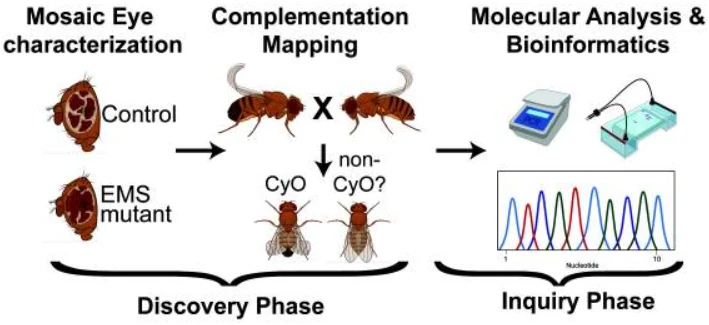
The Fly-CURE involves the characterization and mapping of novel EMS mutants in Drosophila melanogaster. The mutants were all isolated from an EMS Flp/FRT screens utilizing the Drosophila eye as a model system (screens described below). Using the eye as a model system allows for ease of observation by undergraduates utilizing dissecting microscopes commonly available in teaching laboratories. The experiments are conducted by undergraduate students in the Fly-CURE in undergraduate laboratory courses. Each mutant is independently characterized and mapped by students at independent institutions. The experiments in the project fall into three categories, classical genetics, molecular genetics, and bioinformatics. These modules utilize technique and learning objectives that are commonly taught in undergraduate genetics laboratory courses. The difference in the Fly-CURE is that all these experiments are utilized for a single scientific project.
Classical Genetics
The Fly-CURE project starts with each class being assigned a mutant isolated from a Flp/FRT EMS screen. The first step is the characterization of the Flp/FRT mutation and genetic mapping through complementation testing. These experiments involve students learning basic fly husbandry, setting up crosses, and analyzing F1 progeny. This leads to the identification of a region that fails to complement, identifying the approximate location of the mutations, and setting up additional crosses for further genetic mapping. At this stage of the project, students can select a candidate gene to setup the molecular genetics portion of the project.
Molecular Genetics
Each student or group selects a candidate gene from the failure to complement region. By utilizing flybase.org students can look at identified or predicted gene function to select a potential candidate gene for further analysis. Once a candidate gene is selected, DNA is isolated from the mutant and control Drosophila stocks. In parallel, students design PCR primers for their selected candidate gene. Primers are ordered and then the isolated DNA is utilized to setup PCR. PCR success if confirmed by electrophoresis. Given that this is a CURE, additional time is scheduled to allow for problem shooting PCR and gel electrophoresis. Following these experiments, successful PCR experiments are sent for Sanger sequencing to setup the bioinformatics module.
Bioinformatics
When samples are returned from Sanger sequencing, students utilize web-based bioinformatics tools to analyze the sequencing data collected from the molecular genetics module. Students work to trim their sequencing data, confirm the location in the genome that was sequenced, and identify any point mutations in the region sequenced. Students can use one of several genomic browsers to predict the specific amino acid change caused by the mutations. Students then utilize BLAST to compare their candidate gene in Drosophila to the human homolog.
Modular Nature of the Fly-CURE
The Fly-CURE can be taught as a full semester project and can typically be completed in a 15-week laboratory that meets once a week for 3 hours. However, faculty can choose to utilize the project in a modular manner, selecting the parts of the project to implement that fit with the schedule and curricular needs.
Join the Project
- Jacob Kagey
- Professor at University of Detroit Mercy
- kageyja@udmercy.edu